Teaching Practice
Basa Basi Mitsy: Teaching Loan Maths with a Real KPR Calculator
A two-lesson plan that turns a real Indonesian KPR (mortgage) calculator into a maths and financial-literacy class, with worked numbers, Bahasa vocabulary and student tasks.
“Cicilan mulai Rp4 juta sebulan.” My Year 11s see lines like that on billboards on the way to school, and almost none of them can tell me what is behind it. This term every homeroom teacher at our school had to run a financial-literacy block. I teach History and Bahasa Indonesia, not maths, so I needed something concrete enough that I could not get lost in it. I built two lessons around one free tool: a KPR (kredit pemilikan rumah, home loan) calculator from a real Indonesian property portal. It produced the liveliest arguments of my year, which in my book is a win.
Here is the plan, the numbers and the vocabulary, so you can borrow it.
Why a mortgage calculator works in class
Percentages and compound growth feel abstract until there is a house attached. A KPR calculator gives students a model they can poke: change one input, watch three outputs move. It also sneaks in financial literacy — the difference between a monthly payment and the total cost — which they will need long before they buy anything.
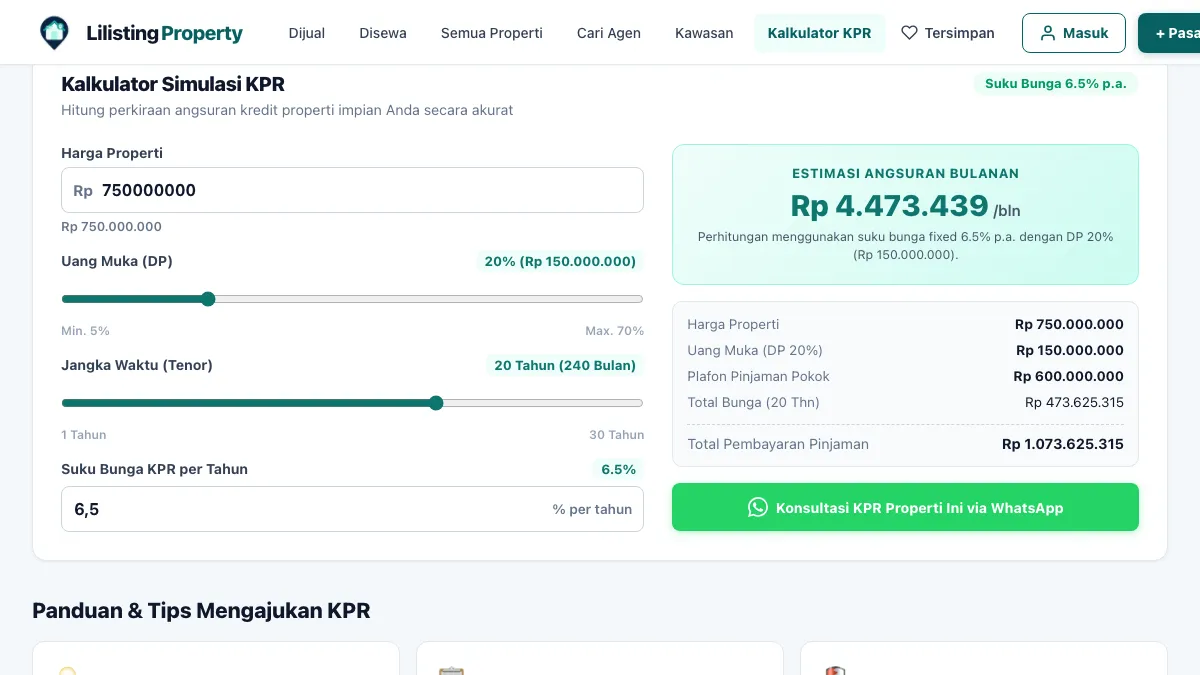
I used the KPR simulator on Lilisting Property . It is free, needs no sign-up, and shows the instalment, the loan principal, the total interest and the total repayment side by side. The down payment slider runs from 5% to 70%, the tenor from 1 to 30 years, and the rate is entered as a fixed annual percentage. That is exactly the set of levers I wanted.
Vocabulary first (Bahasa–English)
I put these on the board before touching the tool:
| Bahasa Indonesia | English | In one line |
|---|---|---|
| Harga properti | Property price | What the seller asks |
| Uang muka (DP) | Down payment | Paid upfront, not borrowed |
| Plafon pinjaman | Loan principal | Price minus DP |
| Suku bunga | Interest rate | Cost of borrowing, per year |
| Tenor | Loan term | How long you repay |
| Angsuran | Instalment | What you pay each month |
| Total bunga | Total interest | Everything paid above the principal |
Lesson 1: explore before explaining
Hook (10 minutes). I open the calculator with its default example: a Rp750,000,000 home, 20% down, 6.5% fixed, 20 years. The instalment comes out at Rp4,473,439 a month. I ask: “Is that cheap?” Hands go up. Then I reveal the line underneath — total interest Rp473,625,315 on a loan of Rp600,000,000. The room goes quiet. That is the lesson.
Explore (25 minutes). In pairs, students change one input at a time and fill in a table. These are the results my class got, which I have since checked by hand:
| Scenario | Monthly instalment | Total interest |
|---|---|---|
| 20% DP, 6.5%, 20 years (default) | Rp4,473,439 | Rp473,625,315 |
| Same, 10 years | Rp6,812,879 | Rp217,545,436 |
| Same, 15 years | Rp5,226,644 | Rp340,795,955 |
| Same, 30 years | Rp3,792,408 | Rp765,266,931 |
| 10% DP, 6.5%, 20 years | Rp5,032,619 | Rp532,828,480 |
| 20% DP, 8%, 20 years | Rp5,018,640 | Rp604,473,699 |
The pattern students spot on their own: stretching from 20 to 30 years cuts the instalment by under Rp700,000 a month, but adds almost Rp300 million in interest. Several of them called it “a trap”, which led to a good discussion about why people still choose long tenors.
Exit ticket. “In one sentence: why does a lower monthly payment not mean a cheaper loan?”
Lesson 2: the formula and the family
Explain (15 minutes). For stronger groups — with a little help from our maths department — I introduce the annuity formula:
M = P × i / (1 − (1 + i)^−n)
where P is the principal, i the monthly rate (annual rate ÷ 12) and n the number of months. We check the default case together on calculators: P = 600,000,000, i = 0.065 / 12, n = 240. Getting Rp4,473,439 by hand, matching the website to the rupiah, is surprisingly satisfying for them.
Apply (25 minutes). I give each group a fictional family with a net monthly income and savings, then introduce the guideline the calculator page itself states: keep total instalments within 30–35% of net monthly income. Working backwards from the default loan, Rp4,473,439 at 30% means a household needs roughly Rp14.9 million a month in net income. For the 10-year version it is about Rp22.7 million.
Groups then decide which scenario their family can afford and present a recommendation. The page also reminds buyers to keep around 4–7% of the price aside for bank fees, insurance and notary costs, so I add that as a twist: can the family still cover it after the down payment?
Honest limits to teach
I make a point of ending with what the model leaves out, because that is real financial literacy:
- The calculator uses a fixed rate. Many real KPR products are fixed for a few years and then float.
- Bank approval depends on documents and credit history, not just a ratio.
- Listing prices come from advertisers and can change.
Students who grasp that a calculator is a model, not a promise, have learned the most important thing in the unit.
Differentiation notes
- Support: give a half-filled table and ask only for the pattern.
- Stretch: ask students to build the formula in a spreadsheet and plot total interest against tenor.
- Bahasa link: students write a short paragraph explaining “tenor” and “angsuran” to a younger sibling, in Bahasa Indonesia.
It is a small tool, but it turned two maths lessons into a real conversation about money — and a few students went home and asked their parents how their own loan works. That is the kind of homework I like.
Pertanyaan yang sering diajukan
What age group is this lesson for?
Do students need to understand the annuity formula?
Apa arti tenor dalam KPR?
Is the calculator result what a bank will offer?